Pink Slip vs Full Car Service — The 2026 Difference (and When You Actually Need Both)
Every year we see drivers who paid $650 for a "combined pink slip and service" at a workshop, believing the two were part of the same regulated job. They're not. One is a $51-cap regulated safety check. The other is a manufacturer-defined maintenance service that can legitimately run into the hundreds. Here's exactly where the line is, and when the combination makes real sense.
- Reviewed by
- NSW Pink Slip Review Panel
- Published
- 4 May 2026
- Updated
- 24 July 2026
- Read time
- 11 min
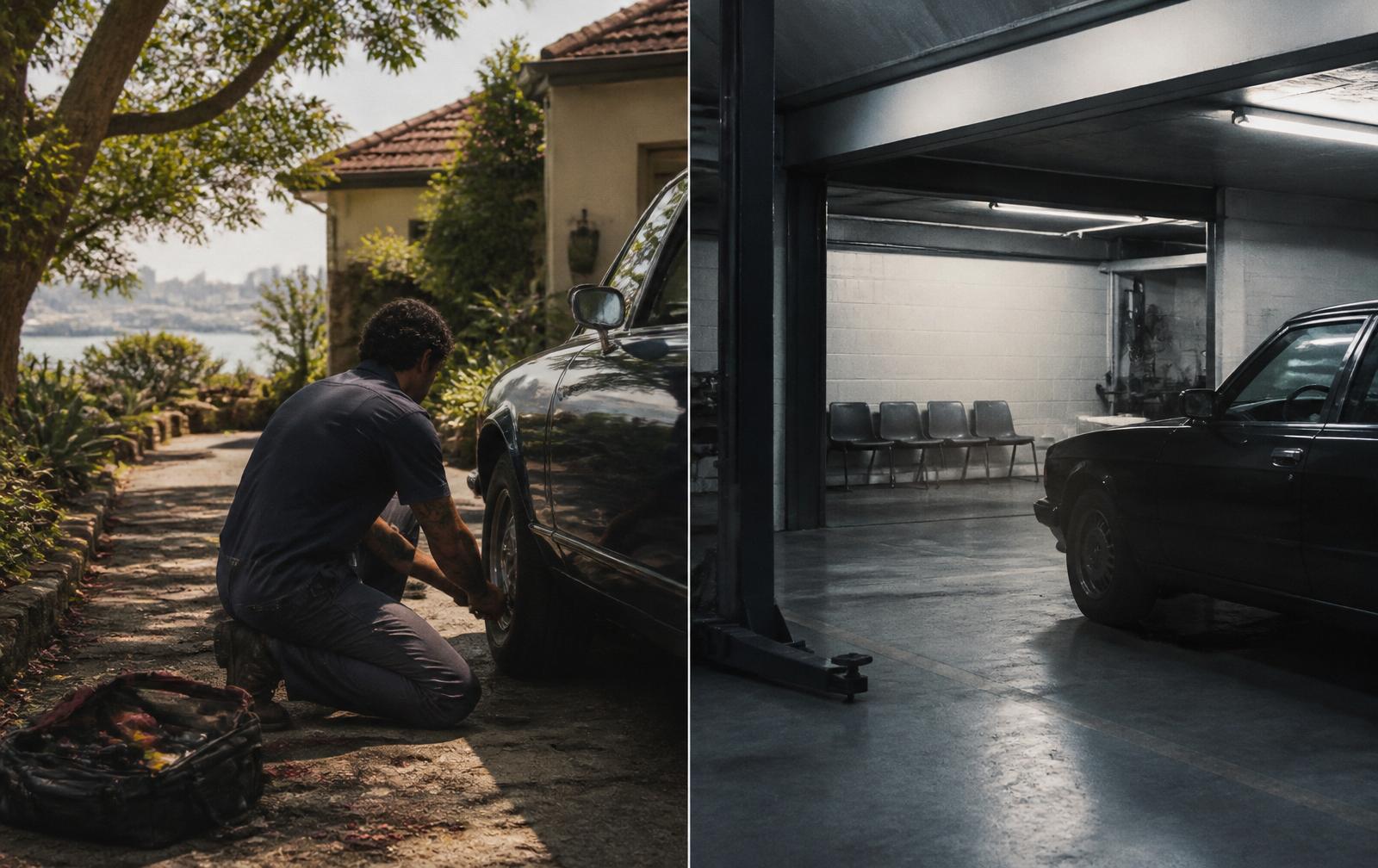
A pink slip and a car service sound similar because both involve a mechanic and both keep your car legal and reliable. They're not the same job — they're not even the same category of work. One is a pass/fail safety inspection regulated by Transport for NSW with a capped government fee. The other is a set of maintenance tasks defined by the manufacturer's logbook, priced by the workshop, with no regulator involvement. This piece walks through both, shows exactly what each covers, and explains when they make sense together versus when a workshop is bundling them to protect margin.
The 30-second difference
| Aspect | Pink slip (eSafety Check) | Full service (logbook) |
|---|---|---|
| What it is | Pass/fail safety inspection | Preventive maintenance |
| Set by | Transport for NSW (AIS scheme) | Vehicle manufacturer |
| Regulated fee | $51 government + station labour | None — market-priced |
| Typical total | $45–$179 | $250–$700+ |
| Time on car | 20–30 minutes | 2–4 hours |
| Result | Electronic lodgement to Service NSW | Stamp in logbook, worksheet |
| Required by law | Yes (from 5th year of rego) | No |
| Affects warranty | No | Yes (skip logbook servicing → risk voiding) |
What a pink slip actually is (and isn't)
A pink slip is a snapshot safety check. The inspector confirms the car meets the minimum roadworthy standard on the day — brakes work, tyres have tread, lights function, seatbelts retract, no perforating rust, no exhaust leak forward of the muffler. Every item is pass/fail against a fixed AIS criteria set. The regulated government fee is $51 maximum; on top of that each station adds its own labour or call-out.
What a pink slip is not: a mechanical health check, a preventive service, a warranty of future reliability, or anything to do with oil, filters, coolant, timing belts, brake fluid replacement, or scheduled maintenance intervals. If your CV boot hasn't split yet but is cracking, it's an advisory — not a fail. Your due timing belt at 100,000km isn't on the checklist at all.
What a "full service" actually is
A logbook service is a set of maintenance tasks defined by the vehicle manufacturer at specific intervals — usually 10,000km or 12 months, whichever comes first. What's included varies by manufacturer and by interval, but a typical minor service covers:
- Engine oil and oil filter change.
- Air filter inspection (replacement at longer intervals).
- Cabin pollen filter inspection or replacement.
- Fluid level top-ups (brake, power steering, coolant, washer).
- Tyre rotation and pressure check.
- Brake inspection (thickness measurement, functional test).
- Battery load test.
- Multi-point visual inspection — belts, hoses, CV boots, exhaust, suspension.
- Diagnostic scan for stored fault codes.
- Reset of the service reminder.
- Logbook stamped with mileage, date and workshop details.
A major service (usually every 40,000–60,000km) adds spark plugs, brake fluid replacement, transmission fluid inspection, coolant replacement, and often the timing belt interval on cars that have one.
Where the two overlap (and don't)
Both jobs measure brake pad thickness. Both look at tyre tread. Both check lights function. On the surface that's overlap — and it's why workshops legitimately bundle them: some of the labour is duplicated. In practice the overlap is 5–10 minutes of work, not the difference between a $179 inspection and a $500 service.
Where they don't overlap is everything under the bonnet. A pink slip inspector doesn't change your oil, doesn't replace the oil filter, doesn't rotate your tyres, doesn't scan for non-emissions fault codes, doesn't reset your service reminder. That's not laziness — it's regulatory scope. An AIS inspector is authorised to inspect against the safety criteria, not to perform mechanical work.
When a "combined" pink slip and service is a good deal
Genuinely — sometimes it is. If all four of these are true, bundling makes sense:
- Your service is actually due this month or overdue.
- The workshop's service price is one you'd have paid anyway (not inflated).
- The workshop is one you trust and use regularly.
- The pink slip line on the invoice is transparent — you can see the $51 government fee separately from the workshop labour, and the workshop labour on the pink slip line is reasonable ($0–$20).
Under those conditions you save an extra trip and roughly 30 minutes of duplicated inspection work. Fair deal.
When "combined" is a trap
The trap is when the workshop uses the pink slip as a foot in the door to sell you a service you didn't need this month, or a "premium" service package with padded line items. Watch for these signals:
- The pink slip line on the invoice is bundled into the service total — no separate $51 government fee visible.
- The service is quoted as "recommended" rather than "due this month per your logbook" — check your last service date; genuinely-due services are usually 11–13 months apart.
- Menu items like "brake system flush", "throttle body clean", or "engine treatment" appear at $80–$150 each without a clear reason. These are usually not on your manufacturer's schedule.
- Wiper blades billed at $60/pair when the standard retail is $30 — small margin theft that stacks up across the invoice.
- A pink slip fail on the same day as a service quote, with the fail items conveniently on things they can fix during the service. Ask for the fail list in writing, then get a second opinion at another AIS.
None of these are always dishonest — some are legitimate upsells for genuine issues. But the way to tell the difference is transparent line items, and a willingness by the workshop to sell you just the pink slip if that's all you want.
Why we deliberately don't bundle
Our pink slip is $179 inc GST, flat. We don't offer a service alongside it, and it's not because servicing is beneath us — it's a deliberate conflict-of-interest choice. An inspector who profits from failing you can't credibly be trusted to pass you when the pass is honest. Every fail we mark either genuinely fails a car for real safety reasons, or it doesn't get marked. There's no third path where a fail turns into a $400 quote in the same session.
That's the whole model. The pink slip is a snapshot; we're transparently paid $179 to do the snapshot honestly; if it fails, you take the fail report to whichever mechanic you trust for the repair, and we come back for the free re-inspection when it's done.
The scheduling reality — why doing them together often doesn't work
A full logbook service takes 2–4 hours on the workshop's ramp. A pink slip takes 20–30 minutes at your driveway. Combining them means you drop the car at the workshop for the morning or the day. If your reason for choosing a mobile pink slip was that you didn't want to lose a workday to a workshop trip, combining defeats the purpose.
Better sequence: book the mobile pink slip in a 30-minute window that suits you (early morning before work, lunchtime, after school pickup). Get the pass lodged. Book the service separately at a workshop when you're happy to be without the car for half a day — potentially even months apart if the service isn't imminently due.
Cost comparison — a realistic 2026 Sydney example
A 2018 Toyota Corolla, 90,000km, due for a minor service in 2 months and needs a pink slip now. Three approaches:
| Approach | Cost | Time out of your day |
|---|---|---|
| Mobile pink slip now, service in 2 months at your workshop | $179 + ~$320 = $499 | 30 min + half day (later) |
| Workshop combined pink slip + minor service now (fair quote) | $60 + $320 = $380 | Half day (all at once) |
| Workshop combined pink slip + "premium" service pack now (padded) | $60 + $580 = $640 | Half day, spending more than needed |
| Mobile pink slip now, service in 2 months at a padded workshop | $179 + $580 = $759 | 30 min + half day (later, still overpaying) |
The winner depends more on which workshop you use for the service than which sequence you pick. The workshop-combined route is genuinely cheaper if the workshop is fair, and genuinely more expensive if it isn't. Our advice: pick your service workshop on service value alone, then pick your pink slip provider on scheduling and honesty. They don't need to be the same shop.
What about "pre-purchase inspection" — is that the same as a service?
No. A pre-purchase inspection (PPI) is a mechanical health check done on a car you're considering buying — it looks at engine condition, transmission wear, service history, accident evidence, and mechanical items well beyond the pink slip scope. It's not a service (nothing is changed or replaced) and it's not a pink slip (it's not an AIS-lodged safety pass). It exists specifically to inform a purchase decision. If you're buying, book a PPI. If you're renewing rego, book a pink slip. If you're maintaining a car you already own, book a service.
Frequently asked.
- Is a pink slip the same as a car service?
- No. A pink slip is a regulated safety inspection (pass/fail) with a $51 capped government fee. A full service is manufacturer-defined preventive maintenance costing $250–$700+. They cover different things and are performed under different regulatory schemes.
- Do I need a service before a pink slip?
- No — the two aren't dependent on each other. A car that's mechanically maintained but hasn't had a scheduled service in a while will still pass a pink slip if the safety items are within spec.
- Can a mechanic fail my pink slip if I don't buy a service?
- They shouldn't — the pass/fail is against the AIS safety criteria, not against whether you buy a service. Transport for NSW audits stations specifically for this. If you suspect this is happening, use a mobile inspector who has no service revenue on the other side of the invoice.
- Does a pink slip include an oil change?
- No — oil changes are service work, not inspection work. An AIS inspector isn't authorised to perform mechanical work as part of the pink slip; they can only inspect against the safety criteria.
- Will skipping a logbook service void my warranty?
- Potentially, on cars still under manufacturer warranty. A pink slip doesn't affect warranty; a missed logbook service can. The two aren't linked from the manufacturer's perspective.
- What's the cheapest way to keep my car legal each year?
- A mobile pink slip at $179 plus rego and CTP through Service NSW. If your car is out of warranty and mechanically sound, you can defer non-critical service items — but check pad life, brake fluid age, and coolant condition yourself or at each pink slip.
- Can a workshop legitimately charge $80+ for the pink slip alone?
- The government fee is capped at $51. Anything above that is station labour, and the station can set that at whatever they choose. $60–$70 all-in is normal for a busy Sydney workshop. Above $80 without justification is unusual.
- Should I get the service and pink slip at the same workshop?
- Only if you already trust the workshop for service work and their pink slip line is transparent. If you don't have a regular workshop, keep the two separate — you get more choice on both and you're not locked in.
- How often do I need each?
- Pink slip: once a year from the 5th anniversary of first registration. Service: as per your manufacturer's logbook, typically every 10,000km or 12 months (whichever first). The two intervals rarely align, so treating them as separate events is usually simpler.
- Is a "safety check" the same as a service?
- No — "safety check" is another name for the pink slip / eSafety Check. It's the same regulated inspection, not a service.
- What if I want both done in one visit?
- Book a workshop that can do both — you'll spend half a day there rather than 30 minutes at home. Ask for the pink slip and service to be quoted as separate line items so you can see the $51 government fee and can compare service prices honestly.
About the author
NSW Pink Slip — Lead Inspection Team
Lead AIS-Authorised eSafety Inspector · 18+ years
Our lead inspection team is Transport for NSW-authorised under the Authorised Inspection Scheme (AIS) to issue eSafety Checks (pink slips) for light vehicles up to 4.5t. Combined 18+ years of hands-on Sydney workshop experience — starting in general repair, moving through diagnostic specialisation on European and Japanese platforms, and settling into full-time mobile inspection since 2019. Every article on this site is authored or reviewed by a currently-authorised AIS examiner. If we can't verify a claim against a Transport for NSW or Service NSW source, it doesn't ship.
- ✓Transport for NSW authorised AIS examiner
- ✓Cert IV in Automotive Mechanical Diagnosis
- ✓Cert III in Light Vehicle Mechanical Technology
- ✓Cert III in Automotive Electrical Technology
- ✓Working with Children Check (WWC) verified
Reviewed by NSW Pink Slip Review Panel — Reviews every technical article for accuracy against current Transport for NSW rules, AIS inspector guidelines and manufacturer service data.
Meet the full inspection team →Related from the workshop.
What Is a Pink Slip in NSW? The 2026 eSafety Check Explained (Plain English)
Pink Slip Cost NSW 2026 — How Much You Actually Pay (Full Price Guide)